Thursday, July 14, 2011

Dance Like No one is Watching: Digging the Paw-so Dog-lé

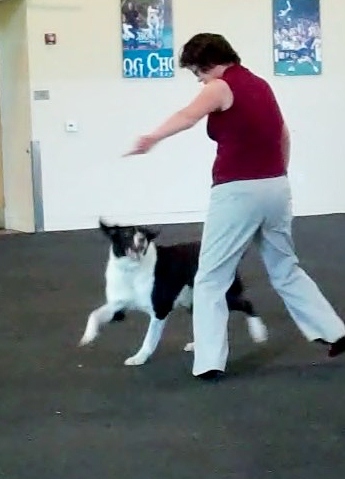
Rennie getting ready to spin.
I’m not an athletic person by any stretch of the imagination. However, I adore dancing.  I’m not good at it, but it makes me happy, and sometimes my body even decides to coincide with the movements in my mind.  And of course, I love dogs.  But even I was a bit wary when I first heard about dog dancing.  Visions of people and dogs wearing matching outfits, Len Gooddog, Bruno Spinoni, and Carrie Ann Ibizan Hound scoring, dogs samba-ing on two feet (yes, I’ve seen the YouTube video and all I can think is that poor dog’s back!)… a circus act, basically.  Not my thing.  Until I actually saw it.

As the former dog training coordinator at ARF, my office was in the Training Pavilion where all the classes took place.  On Friday nights, there is “dog dancing,” otherwise known as canine freestyle (“canine” added so no wannabe rappers show up?), taught by Judy Gamet, owner and creator of Dogs Can Dance.  I listened at first, bobbing and dancing in my chair as I worked at the computer.  Then, giving my eyes a break, I decided to check it out.  Interesting.  Basic commands put to music.  Kind of like aerobics.  I like aerobics (not that I ever do them).  Hmmm.  I put my research skills to work and looked it up on YouTube.  Wow.  Kate and Gin.  OMG WOW! Carolyn Scott and Rookie.  This is cool stuff!

However, time and finances made it easy to hold off on taking a class.  Then, Judy taught a freestyle portion in a Sports Sampler class, and again I took a break to watch.  What caught my eye was an older coonhound /rottie mix.  The owner was trying to get the dog involved in some sport and up until now, the dog had only shown courteous interest.  But all of a sudden, she was transformed!  Her ears went up.  She was prancing!  Her stub tail was moving in time to the music!  She had a little extra wiggle in her walk!  She looked like she was smiling at her handler, saying THIS is what I’m talking about!  Sure, it’s a little corny that it was Elvis’ “Hound Dog”, but what I would later see happening time and time again was that some dogs really enjoy certain music – not the same kind of music for every dog, but each dog has his or her own musical preference.  Apparently, music doesn’t just calm the savage beast, it inspires them.

Yoji, a collie/rockstar mix, is by far my more athletic dog – flying into the air, performing half-twists just to catch a deflated basketball, leaping over ravines on off-leash hikes, and infamously climbing six feet up into a pepper tree just to see what was on the other side of the fence.  I took him to a couple freestyle lessons, and he was o.k., but it was a little sedate for him – no flames or fog machines. At 12, Taro can still get his groove going – he did create the Jindo Hustle after all.  I thought about taking class with him.  However, recalling Rennie’s interest whenever I sashayed around the house with tunes blaring, he seemed the likely candidate.

Rennie, despite being mostly border collie, is almost as physically uncoordinated as I am.  He has mild hip dysplasia, but that doesn’t account for tumbling ass over tea kettle when he goes into zoomies, or falling off the edge of the porch if he’s not paying attention.  But what he lacks in physical prowess, he makes up for in enthusiasm.   He’ll play tug, shag after balls, and best of all, get silly with me without a moment of embarrassment or conscientiousness.  He’s all about the fun of the doing, a lesson I’ve taken to heart.

So, Rennie and I enrolled in freestyle classes.                              

Both of us were in love.  Spins, weaves, passes, cuts – they were all terrific.  Rennie was an eager learner and participant.  His tail keeping rhythm like a metronome, the two of us sailed across the pavilion floor like Fred and Ginger – at least in our minds.  Time sails by, and at the end of class, both of us are exhausted but happy.

I’m not a competitive person, but I am goal oriented and I like knowing when I’m doing well and where I can improve.  However, crowds make me uneasy, so I didn’t have any interest in performing in front of an audience.  The Dog Can Dance Challenge allows dogs and handlers to earn titles by submitting videos that fulfill set guidelines.  Whew!  No live performance necessary!  The challenge is also open to teams (multiple dogs) as well as to dogs and handlers that have limitations based on health and age.  The emphasis of the challenge is on handling skills that showcase the dog.

The Dogs Can Dance Challenge appealed to me, so Rennie and I registered and have just passed our entry level, which focused primarily on handler skills and handler comprehension of freestyle terms.  You can watch a portion of our entry levels.

Completing "Around"
Joining the Dogs Can Dance Challenge wasn’t so much about getting a title as doing something that Rennie and I enjoy doing together (he certainly doesn’t care about letters).  Freestyle has improved our communication and expanded our training vocabulary.  We practice daily in a quiet corner of the local park, usually with me humming or singing off –key.  With the two of us focusing on each other, laughing and having fun, it’s like the rest of the world disappears.  Ren, who can be reactive, suddenly ignores passing dogs, bicycles, and people.  That’s when I know it’s good, when Ren and I can be free to dance like no one is watching.  And it’s good.

Saturday, July 2, 2011

Treat Me Right: The Power of Reinforcement- July Newsletter

Hearing parents tell their children, “Oh, too bad school is starting soon,” and watching parents take their child out of school for the day as a “treat” frustrated me as a teacher.  The underlying implication was that school, and by default learning, was something unpleasant and even punitive.  Students came to school expecting misery and the failure of any lesson to be entertaining confirmed that belief.  In contrast, most people come to dog training classes excited and optimistic, expecting “school” will make their puppy or dog the pet of their dreams.   For owners, dog training is a good thing.  As a primarily positive reinforcement trainer, I want my dog clients equally enthusiastic.  Regardless of species, eager students make teaching fun and challenging.  When training is pleasant and successful, everyone wants to continue with the process.
In training classes, our dogs must work in a place with many attractive distractions.  Verbal praise becomes white noise, especially since dogs don’t understand English.  For most creatures humans included, public displays of affection are rarely appreciated when trying to focus.  Food rewards provide immediate feedback and high value food gives the handler top priority. When tasty morsels are only offered during training, an association between learning and pleasure develop. 

According to Dr. David J. Linden, a neuroscientist who specializes in addiction, tiny portions further reinforce the pleasure/training connectionthe dog must participate in more training to receive more "pleasure".  It's making the dog want more that keeps him or her interested in the session and that longing becomes connected to you and training.  Click here to hear Dr. Linden’s explanation (5-6 minutes into the interview).  Rewarding at a variable rate (rewarding sometimes - which means not at all, a little, or jackpotting at random times) makes a behavior even stronger, once the behavior is established (happens at least 80% of the time on command).  Think of a slot machine.  If it paid all the time in huge amounts, people would only go when they needed money.   If it never paid, what would be the point of playing?  If there are a multitude of possibilities (win nothing, a little, or a jackpot), it makes it more interesting and optimism keeps people playing.
Learning also requires confidence.  Rewarding the correct response encourages exploration, in comparison to punishing the wrong behavior, which creates hesitancy and fear.  Remember the teacher who made students sink into their seat whenever a question was asked? Pop questions rewarded with extra credit or candy usually encouraged much livelier responses, especially when wrong answers only got "good try!"  Our dogs should be the literal teacher’s pet.

The issue of excess calories frequently comes up where food rewards are concerned.  Using food rewards does not necessarily equate to an obese pet.  The size of the portion, as mentioned, is a major issue.  How tiny is tiny?  For medium sized  to large dogs, a treat portion is about the size of half of a pea.  Don't worry.  Dogs will taste it.  Adjust down accordingly, with toy sized dogs getting portions about the size of a grain of rice.  A jackpot is NOT one large piece, but many small pieces.  Dogs somehow understand number or repetitions rather than size.  Ask a three year old human if they prefer one large quarter or ten pennies.  It's the same idea.  Soft treats, rather than crunchy, work better so the dog isn't distracted by chewing. And a training session shouldn't last more than 3-10 minutes, depending on the number of behaviors being taught and your dog's attention span (classes are usually longer to train the humans, not the dogs).  So, figuring the rate of reward with the portion size, treats during training shouldn't make pets obese.  To practice already established behaviors or if the dog is super motivated by any food, train during breakfast using breakfast kibble with a couple extra treats added.  The video below is Rennie working for part of his breakfast.


Must food always be used as a reward?  Of course not.  Toys and privileges can also be used but are distracting and inefficient when a behavior is first being established (“Sit”, throw the ball, wait for dog to return with the ball and drop the ball before repeating).  However, it’s important that the reward is rewarding to the dog.  Brussel sprouts might be healthy, but they don’t do much for motivation.  Cheese, hot dogs, last night's leftovers, even rinsed canned beans are more interesting.  Be creative!   Experiment. With an eager learner awaiting what’s next, the sky’s the limit!

Thursday, June 16, 2011

The Sweet Smell of Success

Yesterday, Yoji and I went into an empty lot during our walk.  There was a damp area in the weeds.  Yoji sniffed it.

“Noooooooo!” I protested,running in classic battle film slow motion.

It was too late.  The Grand Schmear had begun.   

A Grand Schmear is not a regular roll.  A Grand Schmear starts with a look of ecstatic doggy “OH, YEEEEEAAAAAH!”.  The dog descends nose first, followed by simultaneous collapse of front legs and rubbing of the cheek.  Propulsion by the back feet insures maximum contact and pressure as the dog pushes neck, shoulders, ribs and flanks through whatever “oh yeah” is.  Heaven forbid there is no intervention- because it will be repeated on the other side.  Oh, yes, it is definitely a collapse, rub and repeat.

"OH, YEAH!" Another Grand Schmear incident.
Yoji rose from the poo mud (courtesy of a sewer leakage, of course) and gave a glamour slow motion shake, each poo mud droplet glistening in the sun. A sharp couple kicks of his back feet (sound effect: straight razor sharpened on a leather strap) and he was good to go.  He was Yoji-suave.  He surveyed his realm.  His message was clear:  “Wassup, bitches?” – not politically incorrect amongst dogs.

This wasn’t the first time.  The most memorable was The Crab Incident.  I was cleaning crab and Yoji was with me in the kitchen, hoping for a tasty morsel.  Taro and Rennie were in another part of the house.  I slipped Yoji a bit of crab fat. Mmmmm, tasty!  I handed him another bit and he held it carefully in his mouth.  What good is having special treatment if no one else knows about it?  He spit out the fat, got the glazed ecstatic look as I watched in growing horror.  SCHMEAR!!  Needless to say, the other dogs did NOT discover the secret snack as Mr. Yoji was hastily seized and taken to the bathroom for an unprecedented late night bath. Taro and Rennie’s looks were of condemnation, not envy.  

Big deal, so the dog ‘schmeared’, to which I say, only a schmeared dog owner understands.  A Grand Schmear only occurs when there is something spectacularly and unbelievably smelly, sticky, and rare.  Grand Schmear material includes, but is not limited to:  human feces, raccoon feces, horse feces, cow feces (seeing a theme here?), rotted to liquid unknown dead critter, dead fish, and dead earthworms (surprisingly stinky, sticky, and not as rare as one would like – and part of another theme).  In other words, pretty much anything wretch-worthy as the dog is dragged at arms-length to the nearest water source. Ironically, dogs also perform Grand Schmears on carpets and lawns right after getting out of the bath.  

I’m not exactly sure, but it strikes me that a Grand Schmear is a combination of dogs establishing bragging rights and creating a signature fragrance.  Dogs always seem happy and pleased with themselves post-schmear and they appear to make a point of approaching other dogs while schmear-scented.  For example, as a puppy, Camille schmeared herself with dead earthworms and dashed back and forth in front of Stanzi, her big “sister”, making no contact with her, but definitely wanting to be noticed for the discovery.  Stanzi ignored her, but after Camille left, Stanzi hurried to the dead earthworms in the same spot, and schmeared herself as well (it was a bumper bath day at the house).

It doesn’t seem like schmearing is a hunting/food oriented behavior.  Most of the time, the schmear is not edible – the quantity either being nominal or dispersed into the ground and I’ve not seen dogs eat the substance before or after schmearing in it, with the exception of The Crab Incident, but that was an unusual circumstance.  There is a food argument in that the stench could disguise the scent of a doggy predator as it stalks its prey – a thought that perhaps lingers in our dogs’ amygdala. But, to think that our modern-day dogs plan ahead, just in case, seems far-fetched, especially when I see their horrified expression as I put away leftovers (“What?  Let’s eat it NOW!!!  If it’s too much you can always throw it up later!”).  Sure, schmearing might be a vestigial behavior, like spinning before sleeping to flatten the grass, but dogs take so much joy in schmearing, there must be some intrinsic pleasure in it.

A couple things to note:  depending on the source, a dog has anywhere from thousands to millions more scent receptors than people.  That means scent plays an incredibly important role in a dog’s  life and perception of the world as well as identity.  Dogs also have marking glands on their cheeks and chin (as well as on other areas of their body),  leading me to the “signature scent” theory.  When dogs schmear, not only are they applying a fragrance, but they are also leaving their own.  It is both “Look what I found!” and “This is mine!”.  The combination of schmears, knowing what to schmear and what to ignore, gives a discerning dog that bit of je ne sais quoi.

Being on a 10 year search for a signature scent myself, I empathize with Yoji’s quest for a canine cologne with a certain savoir faire.

“Hm, top notes of rotted earthworm, warming to coyote scat and rotted possum gut.  But wait!  What is that finish?  It’s exquisite!  No!  It can’t be!  Can it?  Crab fat!  So inspirational! So memorable!  So YOJI!!”


At $2,000 for a professional nose to design a signature scent, I’m thinking, next spring, what that swath of freesias goes into bloom …. OH, YEEEEAAAAAH! 

Post-schmear bath depression

Thursday, June 9, 2011

Practicing Patience

In an era when instant gratification is a just a button or a mouse click away, we forget about patience until we lose it.  This often occurs when our dogs are behaving in an impulsive and uncontrolled manner such as jumping on us when we return home, bolting through the door, or barking for dinner.  It’s not that our dogs want to try our patience, it’s just that they haven’t been taught how to control their impulses.

Although some dogs have more patience than others, patience, also called “impulse control” can and should be taught.  Dogs that control their frustration can give their handlers a calmer dog and life.  Impulsive behavior usually occurs in high arousal situations, such as feeding time, before going on a walk, or when prey is in sight.  Therefore, training impulse control should not initially happen during those moments.  Like fire drills, practicing appropriate behavior during quieter times yields the best results.

First, decide what behavior you want your dog to perform in high arousal situations.  Then break down the behavior into small simple steps that your dog should be able to perform in two or three tries.  For example, to keep dogs from rushing out the front door, ask your dog to sit and remain calm while rattling the doorknob of a bedroom door.  Be sure to mark (click or say “YES!”) and reward your dog the second he or she relaxes or even hesitates.  Don’t punish the dog for being excited.  He or she hasn’t yet learned your rules and pain or fear creates confusion, arousal and frustration.  Restart at a less exciting level.

Impulse control can also be taught in a reverse order.  For example, ask the dog to sit, and then start adding distractions, smaller ones at first, such as you moving while the dog is sitting.  Gradually build up the distractions so that your dog has a solid “sit” even when a favorite toy or squirrel whizzes past.  Don’t forget to ask for basic commands in different locations as well.  Asking for “random” sits during a walk is creating a stronger “sit” response and new environment in themselves are a distraction. 

Everyday life provides plenty of opportunities for impulse control training as well.  Asking your dog to sit and wait or go to its place when you’re preparing a meal keeps the dog from getting underfoot while working on patience.  Asking for a sit before going outside is also good practice.  Play time is another great opportunity.  To help make the waiting worthwhile, reward your dog a few times for being patient before releasing him or her.  An extra special treat during the wait can give you the upper hand, basically informing the dog that “Sure, there’s good stuff out there, but stick with me, pup, and who knows what great things will come?”

Clearing the Plate - Originally published May, 2011

Chin up, shoulder’s back, eyes forward, hands at eye level, elbows down. Remember what foot starts.  With so many things to consider before the music even starts, is it any wonder why people find ballroom dancing confusing?  Now, think about walking a dog.  Don’t pull, lag, bark, run, wander, or sniff!  There’s just too much on the plate.  Many  people just throw up their hands and clip on a retractable leash, which by its very design rewards all the undesirable walking behaviors.

Our plate is always full of things we don’t want our dogs to do.  It doesn’t help that what we do want our dogs to do frequently goes against canine instinct.  We want our dogs to walk at our side, sit for extended periods of time, have eye contact with us and walk in a straight line.  So, when we ask our dogs to stop acting according to their nature, it confuses them and they resort to the next natural behavior on their list, which frequently is equally displeasing.  This forces dogs and owners to play a frustrating game of elimination.

Focusing on just one behavior at a time can make life easier and clearer for everyone. It takes away the burden of being hyper vigilant.  This can work for desired and undesired behaviors.  Focus on the behavior that is the most important or frustrating.  If pulling on the leash is the behavior that ruins a walk, then focus only on not rewarding pulling, but don’t worry about lagging behind or sniffing or barking.  Work on those behaviors after the pulling has been solved.  Be aware that controlling behavior with management tools only works when the tools are in place, and doesn’t solve the problem.  Once the tool is removed, the behavior returns.

Often, training one desired behavior can eliminate other unwanted behaviors.  In dog trainer lingo, it’s called creating an incompatible behavior. For example, teaching dogs to walk at your side means that by default the dog is not running ahead, lagging behind, or wandering.  Teaching dogs to go to their bed when the doorbell rings solves jumping up to greet people, rushing out the door, and uncontrolled barking at the door. Training just one behavior has solved several other problems. 

When bad behaviors become overwhelming, clear the plate.  Picture the one thing you want the dog to do in the situation, rather than what you don’t want the dog to do.  If you need help with either creating or implementing your vision, contact The Collaborative Dog and we’ll come up with a solution that’s rewarding for everyone.

Star Quality - Originally published May, 2011

My husband is just like Gerard Butler, minus the accent, the suave wardrobe, the full head of hair, and the rippling six-pack.  Actually, although my husband is partially of Scottish descent, he doesn’t resemble Gerard Butler at all.  I suspect even Gerard Butler or any celebrity sans make-up, wardrobe, lighting, and a personal trainer doesn’t resemble the star we see on film or the red carpet.  Still, we accept and expect that our loved ones aren’t like movie stars.  So, why is it that we expect our dogs to live up to celebrity standards?
We frequently choose dogs based on their resemblance to their star cousins, like Lassie, Eddie, the Beverly Hills Chihuahuas, and even the 101 Dalmatians.  Perhaps because of this, there is the expectation of the same behavior.   We want our dogs to rescue Timmy from the well, tilt their head as they listen sympathetically, and cavort companionably with their cohorts.  They should always come whenever they are called, lay quietly in the background until their services are needed, and only relieve themselves to make a statement.  It’s easy to be dazzled by these celebridogs.  They are beautiful and low maintenance.  However, like their cinematic human counterparts, movie dogs have trainers, stunt doubles, groomers, and re-takes.
Lassie infamously was not only male, but also several dogs, each specializing in a talent, selected for his coloring so that they all appeared as one dog on screen.  Dogs that did their own stunts, such as the original Sandy (from Annie) and Eddie, were adopted from shelters, selected for stardom because of their high energy and drive, the exact same traits that probably landed them in a shelter in the first place.  Celebrity dogs spend hours working with their trainers, providing them with plenty of mental and physical exercise and practice.  Even so when filming, like all actors, acting dogs are given an unknown number of opportunities to get their tricks right.  They’re not necessarily one take wonders.  And let’s not forget computer generated images when the trick is dangerous or the picture perfect dog simply isn’t up to task.  Simply stated, the real dogs bear little resemblance to their reel counterparts. 

That is not to say that we should resign ourselves to rude and unpleasant dogs at home and leave good behavior to the silver screen.  Our doggie divas and divos deserve to have their own star quality polished.  We just need to expand our expectations to what happens “behind the scenes.”  Just as a personal trainer, wardrobe, and stylist can bring us a little closer to resembling Brangelina, having additional members on your dog’s team can help Lulu be a little more Lassie.  Training our dogs helps them shine, bringing them closer to being the dogs of our dreams.   Training also helps us gain insight into our dogs’ behavior and personality, creating a new appreciation for our dogs just being themselves and not some illusion.  Best of all, while working with our dogs, we can enjoy the lighter moments as well as the accomplishments.  In real life, bloopers are always included.

Parlez-vous Doglais? - Originally published April 2011

Eager faces and wagging tails sometimes make us forget that dogs aren’t born understanding “human”. Some aren’t even fluent in “dog”.  Training is teaching English (or German or French) as a second language and introducing “human” culture to another species.
Learning another language is challenging.  Listening and repeating, mneumonic devices (remember “s-o-c-k-s”?), and computer programs are all methods for human language acquisition, but research shows voluntary immersion is the ideal.  Hasn’t everyone fantasized about learning français by spending a year in Provence?

Total immersion in a foreign land increases the rate of language acquisition, but increases stress and depression dramatically. Voluntary immigrants go through a pattern of euphoria, depression and acceptance as they adapt to their new home.  However, remaining in a transferred community of the originating culture can prevent acquisition of a new language/culture from happening at all.  Ideally, there is a balance between total immersion and maintaining native language and culture.  The same can be applied to dogs.

Many dogs find total immersion into the human world confusing and stressful.  Much of the behavior we expect from our dogs goes against dog “culture”. Many behavior issues are dogs reverting to their familiar “native culture”. Fear, pain, and intimidation add stress, making “language acquisition” more difficult since the dog’s focus shifts from learning to avoidance.  By working with dog culture, we can teach behaviors that are relevant to dogs and acceptable in human surroundings.

When training becomes frustrating, take a moment.  Remember, that  puzzled face and hesitantly wagging tail is an eager foreigner, trying to understand our mysterious, two-legged world.  Donde esta la biblioteca?
Creative Commons License
Doglish by Kou K. Nelson is licensed under a Creative Commons Attribution-NonCommercial-NoDerivs 3.0 Unported License.
Based on a work at www.thecollaborativedog.blogspot.com.
Permissions beyond the scope of this license may be available at www.kouknelson.com.